Introduction
In 2026, marketing is no longer about sending mass emails or running isolated campaigns. It is about delivering the right message, to the right audience, at the right time—consistently and at scale. This level of precision requires more than just creativity; it requires powerful tools that combine data, automation, and customer insights. That is where CRM tools with marketing automation capabilities become essential.
Customer Relationship Management (CRM) platforms have evolved into comprehensive growth engines. They now integrate marketing automation, sales pipelines, customer service, and analytics into one unified system. Businesses that leverage these tools effectively can dramatically increase efficiency, improve conversion rates, and maximize return on investment (ROI).
This article provides a complete comparison of the best CRM tools for marketing automation in 2026, focusing on features, pricing, and ROI. You will gain a deep understanding of how these platforms work, what makes them different, and which one is best suited for your business goals.
Understanding CRM and Marketing Automation
What Is CRM in the Context of Marketing?
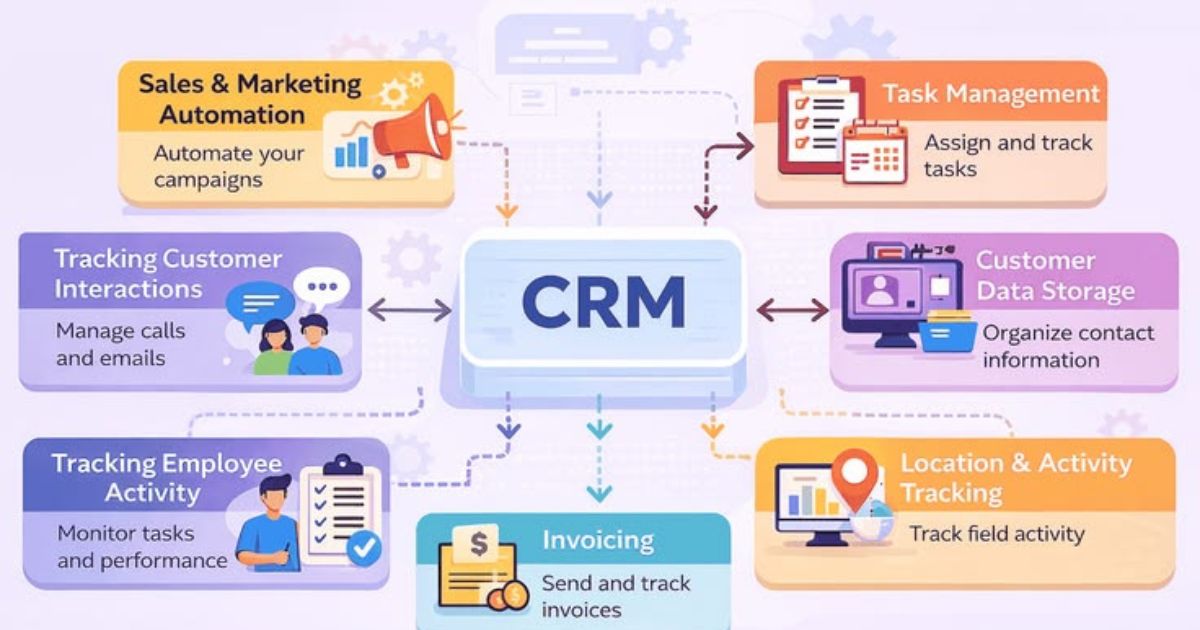
CRM is not just about storing customer data—it is about using that data to build meaningful relationships. In marketing, CRM systems allow businesses to:
- Track customer interactions across channels
- Segment audiences based on behavior
- Personalize campaigns
- Measure campaign performance
What Is Marketing Automation?
Marketing automation refers to the use of software to automate repetitive marketing tasks such as:
- Email campaigns
- Lead nurturing
- Social media posting
- Customer segmentation
- Campaign tracking
When combined with CRM, marketing automation becomes significantly more powerful because it is driven by real customer data.
Why CRM + Marketing Automation Matters
The integration of CRM and marketing automation provides several advantages:
- Unified customer view
- Better targeting and personalization
- Increased efficiency
- Higher conversion rates
- Improved ROI
Modern CRM platforms act as the central hub for all marketing activities, enabling businesses to manage the entire customer journey seamlessly.
Key Criteria for Choosing the Best CRM for Marketing Automation
Automation Capabilities
Look for platforms that offer:
- Workflow automation
- Email sequences
- Behavioral triggers
- Lead scoring
Ease of Use
A CRM should be easy to implement and use daily. Tools with intuitive interfaces reduce onboarding time and improve team adoption.
Integration Ecosystem
The best CRM tools integrate with:
- Email platforms (Gmail, Outlook)
- E-commerce systems
- Social media tools
- Analytics platforms
Pricing and Scalability
Choose a CRM that fits your current budget but can scale as your business grows.
Analytics and Reporting
Advanced analytics are essential for measuring campaign success and optimizing ROI.
Top CRM Tools for Marketing Automation in 2026
HubSpot CRM
Overview
HubSpot is widely recognized as the leading CRM for marketing automation, especially for small to medium-sized businesses. Its all-in-one platform integrates marketing, sales, and customer service tools.
Key Features
- Email marketing automation
- Lead nurturing workflows
- Landing page builder
- CRM database with unlimited contacts
- AI-powered content and campaign tools
HubSpot’s biggest strength is its seamless integration between marketing and sales, creating a unified customer journey.
Pricing
- Free plan available
- Starter plans begin around $20/month
- Advanced marketing features can cost significantly more depending on contacts
ROI Potential
HubSpot delivers strong ROI for businesses focused on inbound marketing and lead generation. However, costs can increase as your database grows.
Best For
- Startups
- Content-driven marketing teams
- Businesses prioritizing ease of use
Salesforce CRM
Overview
Salesforce is the most powerful and customizable CRM platform, offering advanced marketing automation through its Marketing Cloud.
Key Features
- Advanced workflow automation
- AI-powered insights (Einstein AI)
- Customer journey mapping
- Omnichannel marketing campaigns
Salesforce offers unmatched customization and scalability, making it ideal for complex marketing operations.
Pricing
- Starts around $25/user/month
- Advanced plans can exceed $150/user/month
ROI Potential
High ROI for large businesses with complex needs, but requires significant investment in setup and management.
Best For
- Enterprises
- Large marketing teams
- Businesses needing deep customization
Zoho CRM
Overview
Zoho CRM is known for its affordability and comprehensive feature set, making it a strong competitor for small and growing businesses.
Key Features
- Multichannel marketing automation
- AI assistant (Zia)
- Workflow automation
- Campaign management tools
Zoho provides enterprise-level features at a fraction of the cost of competitors.
Pricing
- Free plan available
- Paid plans start around $14/user/month
ROI Potential
Excellent ROI due to low cost and robust features, especially for small to mid-sized businesses.
Best For
- Budget-conscious businesses
- Growing teams
- Businesses needing customization
Pipedrive
Overview
Pipedrive is a sales-focused CRM that includes basic marketing automation features.
Key Features
- Visual sales pipeline
- Email integration
- Activity tracking
- Basic automation tools
Pricing
- Starts around $14/user/month
ROI Potential
High ROI for sales-driven teams but limited marketing automation capabilities.
Best For
- Sales-focused businesses
- Freelancers and small teams
Freshsales (Freshworks CRM)
Overview
Freshsales offers a balance between usability, automation, and affordability.
Key Features
- AI-powered lead scoring
- Email and SMS campaigns
- Workflow automation
- Built-in communication tools
Freshsales stands out for its fast setup and user-friendly interface.
Pricing
- Free plan available
- Paid plans vary based on features
ROI Potential
Strong ROI for small businesses looking for quick implementation and moderate automation.
Best For
- Small businesses
- Teams needing quick deployment
Monday Sales CRM
Overview
Monday Sales CRM is a flexible platform designed for collaboration and workflow automation.
Key Features
- Custom workflows
- Visual dashboards
- Automation recipes
- Team collaboration tools
Pricing
- Starts around $12/user/month
ROI Potential
Good ROI for teams that need customization and collaboration features.
Best For
- Teams with complex workflows
- Collaborative environments
Feature Comparison of Top CRM Tools
Marketing Automation Features
| Feature | HubSpot | Salesforce | Zoho CRM | Freshsales | Pipedrive |
|---|---|---|---|---|---|
| Email Automation | Yes | Yes | Yes | Yes | Limited |
| Lead Scoring | Yes | Yes | Yes | Yes | Limited |
| AI Integration | Strong | Advanced | Moderate | Moderate | Basic |
| Campaign Management | Advanced | Advanced | Strong | Moderate | Basic |
| Ease of Use | Very Easy | Complex | متوسط | Easy | Very Easy |
Pricing Comparison
| CRM Tool | Free Plan | Starting Price | Advanced Pricing |
|---|---|---|---|
| HubSpot | Yes | $20/month | High (contact-based) |
| Salesforce | No | $25/user/month | $150+ |
| Zoho CRM | Yes | $14/user/month | $40+ |
| Freshsales | Yes | Varies | Moderate |
| Pipedrive | No | $14/user/month | Moderate |
ROI Analysis: Which CRM Delivers the Best Value?
HubSpot ROI
- High for inbound marketing
- Excellent for lead generation
- Costs increase with scale
Salesforce ROI
- High for enterprises
- Best for complex workflows
- Requires significant investment
Zoho CRM ROI
- Best value for money
- Strong features at low cost
- Ideal for growing businesses
Freshsales ROI
- Fast implementation
- Good balance of features and cost
Pipedrive ROI
- Best for sales teams
- Limited marketing ROI
Real User Insights from the Market
Insights from real users highlight key differences between CRM platforms:
“HubSpot → super clean UI, but gets expensive fast”
“Zoho → more affordable, but feels a bit clunky”
“Salesforce → insanely powerful, but overkill for small teams”
These insights reflect common trade-offs:
- Ease of use vs cost
- Power vs complexity
- Flexibility vs simplicity
How to Choose the Right CRM for Marketing Automation
Choose HubSpot If:
- You want an all-in-one marketing platform
- You value ease of use
- You rely heavily on content marketing
Choose Salesforce If:
- You need advanced customization
- You run complex campaigns
- You have a large team
Choose Zoho CRM If:
- You want the best value
- You need flexibility
- You have a limited budget
Choose Freshsales If:
- You want quick setup
- You need built-in communication tools
Choose Pipedrive If:
- You focus on sales rather than marketing
Implementation Tips for Maximum ROI
Start with Clear Goals
Define what success looks like:
- More leads
- Higher conversion rates
- Better customer retention
Automate Strategically
Focus on high-impact automation such as:
- Lead nurturing
- Email campaigns
- Customer segmentation
Train Your Team
Ensure your team understands how to use the CRM effectively.
Monitor and Optimize
Continuously analyze performance and adjust strategies.
Future Trends in CRM and Marketing Automation
AI-Driven Marketing
AI will play a larger role in:
- Predictive analytics
- Personalized campaigns
- Automated decision-making
Hyper-Personalization
Businesses will deliver highly tailored experiences based on real-time data.
Omnichannel Integration
CRM platforms will integrate all communication channels into a single system.
No-Code Automation
More tools will allow users to create workflows without technical skills.
Conclusion
Choosing the right CRM for marketing automation is one of the most important decisions a business can make in 2026. The right platform can significantly increase efficiency, improve customer engagement, and drive revenue growth.
HubSpot, Salesforce, Zoho CRM, Freshsales, and Pipedrive each offer unique strengths. The best choice depends on your business size, budget, and marketing strategy.
- HubSpot excels in usability and inbound marketing
- Salesforce leads in power and customization
- Zoho CRM offers the best value
- Freshsales balances simplicity and functionality
- Pipedrive focuses on sales efficiency
Ultimately, the best CRM is the one that aligns with your goals and helps you deliver consistent, personalized experiences to your customers.
Investing in CRM and marketing automation is not just about technology—it is about building a scalable, data-driven foundation for long-term business success.